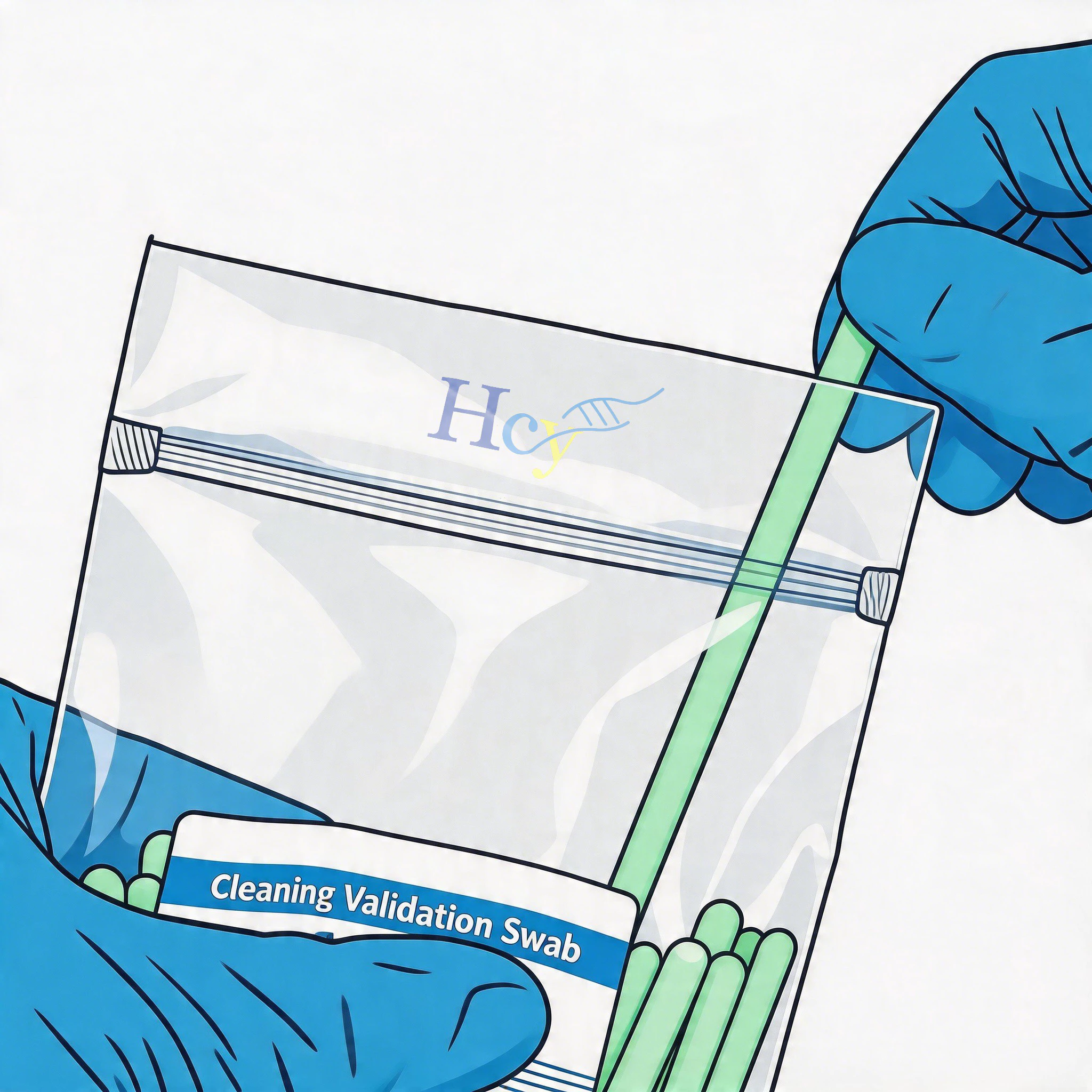
Introduction: The Unseen Gatekeeper of Your Cleanroom Data
In the meticulous world of biopharmaceutical manufacturing, a single errant carbon molecule can feel like a rogue elephant in a sterile room. Cleaning validation is the discipline that keeps that elephant out, and Total Organic Carbon (TOC) analysis is its sharpest eye. Yet, for all the sophisticated millions spent on Sievers analyzers and HPLC columns, the entire validation edifice often rests on a humble, six-inch stick of polyester: the sampling swab.
If you’ve ever stared at an outlier TOC peak and wondered if the problem was your reactor or your recovery technique, you know the frustration. Regulatory bodies like the FDA (21 CFR Part 211) and the EMA (EU GMP Annex 15) don’t just require you to clean; they require you to prove you cleaned. And that proof begins with a swab that doesn’t lie to you.
This guide provides a rigorous, step-by-step protocol for selecting the right TOC swab. Follow these steps, and you’ll stop second-guessing your swabbing technique and start trusting your data.
Step 1: Defining Your Sampling Surface (Know Thy Terrain)
Before you even open a swab wrapper, you must map the battlefield. Not all stainless steel is created equal, and that filling needle crevice is a universe apart from a flat tank wall.
Flat, Electropolished Stainless Steel: This is the gold standard surface in bioprocessing. Here, you need maximum contact and complete solvent release.
Swab Head Recommendation:Large-head polyester knit. The open structure of knitted polyester traps residues effectively but, crucially, releases them almost entirely when vortexed in water. A large head ensures you cover the required 25 cm² or 100 cm² area efficiently without pressing so hard you shed fibers.
The TOC Consideration: Flat surfaces are forgiving, but over-sampling with a dry swab can generate static and actually repel residues. Ensure your swab material is hydrophilic and designed for low TOC background (<50 ppb).
Irregular Geometries (Valves, Flanges, Fill Needles, O-rings):
Swab Head Recommendation:Small-tip polyester or specialized foam. The enemy here is “shadowing”—missing the crevice entirely. A rigid but thin polyester tip (often on a longer, breakable handle) allows you to reach the seat of a diaphragm valve without contaminating the shaft on the way in. For extremely rough surfaces, a medical-grade polyurethane foam swab can provide better surface scrubbing action.
The “Hidden” Surface: Be wary of sampling ports. They are often the dirtiest part of the line and the easiest to contaminate during the swabbing process itself.
Step 2: Matching Swab to Analytical Method (TOC, HPLC, or Both?)
This is where many protocols stumble. A swab perfect for TOC might ruin your HPLC column.
Scenario A: TOC Analysis Only (The Most Common Scenario)
The Requirement: You need a swab with virtually zero inherent carbon leaching. Cotton is a forensic nightmare for TOC; it sheds millions of carbon particles.
The Solution:Cleanroom-laundered polyester knit. Look for swabs that are certified low-TOCand, ideally, pre-cleaned using a proprietary process that strips manufacturing residues without leaving detergent residue. This ensures your blank control actually reads “0 ppb” instead of “Oh no, that’s 150 ppb from the swab itself.”
Technical Insight: Check the swab’s recovery rate documentation. A swab that traps 95% of the residue but only releases 50% of it to the vial is a compliance liability. You need a swab engineered for high sample release efficiency (>90%).
Scenario B: TOC and HPLC/UV (Dual-Purpose)
The Danger: Some swab adhesives or processing aids leach into the extraction solvent. You won’t see them on TOC, but you will see a ghost peak on your HPLC chromatogram.
The Solution: Use only adhesive-free or thermal-bonded swabs. Verify that the swab lot has been tested for extractables using the exact solvent (usually Low TOC Water or a specific mobile phase) you intend to use.
Scenario C: TOC and Microbiology (The Two-in-One Dream)
You want one swab for chemistry and bugs.
The Solution:Sterile, individually wrapped polyester swabs. Ensure the packaging is validated for sterility (gamma irradiated) and that the swab material itself is non-bacteriostatic. This avoids running two separate sampling rounds on the same port.
Step 3: Establishing a Consistent Swabbing Technique (The Human Factor)
You can buy the world’s best swab, but if you hand it to two different technicians, you will get two different TOC results. This is the single largest source of variability in cleaning validation. You must script the motion.
The Template Rule: Always use a disposable, sterile swabbing template (usually 5 cm x 5 cm or 10 cm x 10 cm). Freehand “eyeballing” the area is not defensible during an audit.
The Motion Pattern:
First Pass: Horizontal strokes, side-by-side, across the entire template area.
Second Pass: Rotate the swab 90 degrees and perform vertical strokes over the same area.
Third Pass (Optional but Critical for Roughness): Rotate the swab tip to use the side edge and trace the perimeter of the template.
Pressure Control: You are not scrubbing a grill in your backyard. Firm, consistent pressure—enough to remove residue but not enough to crush the swab head or flake off polyester fibers—is key. Practice using a balance scale to get a feel for consistent pressure.
The Break-Point Transfer: Use swabs with a pre-scored breakpoint handle. After sampling, hold the vial lid open with one hand, snap the swab tip cleanly into the vial, and close immediately. Never touch the swab tip to the vial lip. This reduces cross-contamination risk to near zero.
Step 4: Verifying Swab Suitability (The Recovery Study)
This step happens in the lab, before the manufacturing run. You cannot simply trust the swab’s marketing brochure; you must verify it on your surfaces with your product.
Blank Controls: First, run a blank. Drop a swab directly into TOC water without swabbing a surface. The result must be <0.05 ppm (50 ppb) . This confirms the swab’s low-background certification is valid.
The Spike Recovery Study: Apply a known concentration of your worst-case residue (e.g., 10 µg/cm² of your API) to a clean test coupon of the same material as your equipment. Swab it using the Step 3 protocol. Analyze.
Acceptance Criteria: Your Recovery Factor should be >70% (industry best practice aims for >80-95%). This recovery factor is then used to correct your field sample results. Without this step, your cleaning limit calculations are simply guesswork.
Lot Traceability: Keep the swab lot number in your lab notebook. If a swab lot changes, you need to verify that the TOC background and recovery profile remain consistent. Reputable manufacturers supply a Certificate of Analysis (CoA) with every lot showing TOC background and extractable test data.
Step 5: Using Pre-Assembled TOC Validation Kits (Streamlining the Workflow)
In a busy QC microbiology lab, time is contamination’s best friend. The more steps between the swab and the analyzer, the higher the risk of a false positive.
This is where pre-assembled TOC validation kits become the silent workhorse of a robust program. A well-designed kit eliminates the “bag of swabs and bag of vials” approach.
The Kit Advantage: The kit contains pre-cleaned TOC swabs and matching, certified Low TOC vials (often 40mL). The swab may even be pre-scored for a clean break at the vial height.
Workflow Efficiency: The technician opens one outer bag, grabs the swab, samples, snaps the tip into the exact vial designed for the analyzer, and logs the pre-printed lot number. This reduces handling time and virtually eliminates cross-contamination from production to lab.
Instrument Compatibility: When selecting kits, ensure the vial dimensions are compatible with major TOC analyzers, including Sievers (M9/M500 series), Tekmar Dohrmann, and Anatelautosamplers. Using a universal vial neck size prevents jamming the instrument’s delicate gripper arm.
Conclusion: Trust, But Verify with the Right Tools
Selecting a TOC swab is not a commodity procurement task; it is a critical process decision that impacts the integrity of your cleaning validation data package. The best swab is not the most expensive—it is the one that is transparent about its background levels, consistent in its recovery efficiency, and ergonomic for your sampling team.
When reviewing your next batch of swabs or validation kits, ask your supplier for the data behind the swab. Look for:
Compatibility verification with Sievers and other leading TOC platforms.
Lot-specific traceability for audit readiness.
By following this step-by-step protocol, you move beyond simply “swabbing the tank.” You build a defensible, robust process that ensures the only carbon the analyzer sees is the carbon you’re looking for—and not the carbon you brought in with you.
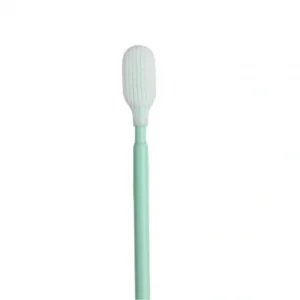
CY-761 is a long-handled, woven polyester swab for surface sampling in cleaning validation. Also suitable for precision cleaning and liquid application. Form CY-761 Polyester Swabs Box...
We value your privacy We use cookies to enhance your browsing experience, serve personalized ads or content, and analyze our traffic. By clicking "Accept All", you consent to our use of cookies. Our Privacy Policy
 A professional supplier of swabs