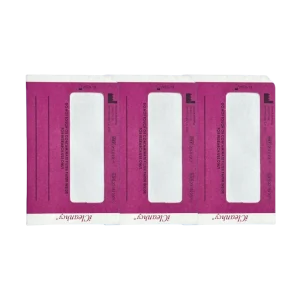
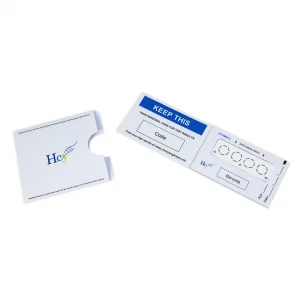
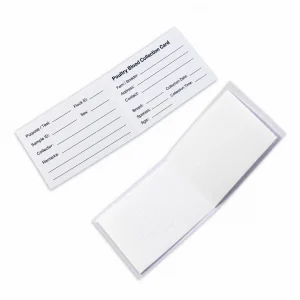
Newborn screening (NBS) is one of public health’s greatest success stories. A few drops of blood, collected in the first hours of life, can detect dozens of rare but treatable conditions—from phenylketonuria to congenital hypothyroidism. For parents, it is a moment of reassurance. For laboratories, it is a complex chain of precision, where the weakest link is often the first: the blood collection card.
In the world of dried blood spot (DBS) testing, not all cards are created equal. A poorly manufactured 5-well card does not merely cause inconvenience; it can lead to sample rejection, delayed diagnoses, or, in the worst cases, false negatives. For large-scale screening programs—where thousands of samples pass through automated analyzers daily—the choice of collection card is a decision with profound clinical and operational implications.
This guide strips away the marketing jargon and walks you through the five non-negotiable criteria for selecting a 5-well blood collection card. By the end, you will understand why the quietest component in your workflow is actually the one worth scrutinizing most closely.
Critical Criteria for Selection
Standard 1: Biocompatibility – The Chemistry of Accuracy
Blood collection cards are not just paper. They are a biological interface. The moment blood touches the card, a chemical interaction begins. If the paper contains optical brighteners, surfactants, or residual acids, it can interfere with downstream assays—particularly PCR-based tests, where even trace inhibitors can suppress amplification and skew results.
For newborn screening, where analytes are often present at low concentrations, the substrate must be inert. The ideal card uses 100% pure cotton fiber with a neutral pH, free from anything that might mask or degrade target molecules.
Huachenyang’s 5-well card is engineered to meet this exact threshold. Its medical-grade paper is manufactured without additives that compromise assay integrity, ensuring that what reaches the analyzer is an unaltered representation of the infant’s metabolic profile.
Standard 2: Printability & Traceability – The Chain of Custody
In high-throughput screening, sample traceability is not a luxury—it is a legal and clinical mandate. Every card must bear unique patient identifiers, collection timestamps, and barcodes that remain legible through storage, transport, and automated processing.
The challenge? Many cards feature pre-printed information zones that smudge under humidity, or coatings that repel thermal transfer ribbon, leading to unreadable barcodes. A card that cannot be reliably scanned becomes a bottleneck, forcing manual intervention and increasing the risk of misidentification.
A well-designed 5-well card offers a matte, receptive surface optimized for thermal transfer printing. It resists abrasion and remains scannable even after weeks in transit or freezer storage.
Huachenyang’s 5-well card is engineered to meet this exact threshold. Its dedicated information zones are formulated to bond with high-quality thermal transfer ribbons, delivering crisp, durable barcodes that survive even the most demanding logistical chains.
Standard 3: Physical Durability – Built for the Real World
A 5-well card may look simple, but its physical structure determines two critical outcomes: sample integrity and automated processing reliability.
First, consider cross-contamination. The five wells must be sufficiently spaced and the card material must resist wicking—the lateral spread of blood across the card—to prevent mixing between wells. This is especially vital when multiple analytes are tested from a single patient.
Second, consider mechanical robustness. Automated punching systems—such as those from PerkinElmer or Tecan—extract precise 3.2 mm discs from each well. If the card is too thick, it jams the punch head. If it is too thin, it curls or delaminates, causing misalignment. Cards must also resist tearing when opened by gloved hands under time pressure in a busy clinic.
Huachenyang’s 5-well card is engineered to meet this exact threshold. With a precisely calibrated thickness of 0.35 mm—the industry standard for automated equipment—and reinforced perforations that prevent fiber shedding, it offers the structural consistency that high-volume labs depend on.
Standard 4: Humidity & Environmental Resilience – The Hidden Variable
Newborn screening programs operate everywhere from tropical clinics to remote Arctic communities. A card that performs perfectly in a climate-controlled lab may fail spectacularly in a humid field setting.
Absorbent cards can draw moisture from the air, leading to uneven blood diffusion, hemolysis, or mold growth during transport. The best manufacturers address this with two strategies: hydrophobic coatings on the card’s backing to prevent moisture ingress, and individual foil pouches with desiccants that maintain stability until the moment of use.
A truly robust 5-well card also demonstrates consistent hematocrit recovery—meaning that the relationship between blood spot size and actual blood volume remains predictable, even across different environmental conditions.
Huachenyang’s 5-well card is engineered to meet this exact threshold. Each card is packaged in a high-barrier foil pouch with integrated desiccant, and the proprietary fiber formulation minimizes the “halo effect”—the uneven spreading that plagues lesser cards—ensuring reproducible spot morphology regardless of ambient humidity.
Standard 5: Regulatory Compliance & Lot-to-Lot Consistency
If there is one unforgivable sin in diagnostic manufacturing, it is variability. A screening program cannot afford to recalibrate its assays every time it opens a new box of cards. Lot-to-lot consistency is not a preference; it is a regulatory requirement under frameworks like ISO 13485, IVDR, and CLIA.
The gold standard supplier provides full traceability: certificates of analysis for each lot, validated performance data, and evidence of ongoing stability testing. They treat collection cards not as commodities, but as precision medical devices.
Huachenyang’s 5-well card is engineered to meet this exact threshold. Manufactured under ISO 13485-certified quality management systems, each production lot undergoes rigorous testing for thickness, absorbency, uniformity, and print durability—ensuring that batch 001 is indistinguishable from batch 001,000.
Cost vs. Value: Why “Cheap” Is Expensive
When procurement departments focus only on unit price, they often overlook a critical metric: total cost of operation.
A low-cost 5-well card may save a few cents per unit. But if it arrives with inconsistent absorbency, laboratories face increased repeat rates. If the coating fails, automated equipment jams, and technicians spend hours clearing punches. If the barcode fades during shipment, samples are logged manually—or rejected outright.
Consider the math: A single rejected sample in a high-volume newborn screening program requires re-collection, which involves contacting the family, dispatching a phlebotomist, and re-running the assay. The cost—in labor, logistics, and most importantly, delayed diagnosis—dwarfs the upfront savings on consumables.
By contrast, a premium card like Huachenyang’s 5-well design delivers predictable performance from the first spot to the last. Its reliability reduces repeat rates, eliminates downtime, and gives laboratory staff confidence that every sample will reach the analyzer intact.
Final Recommendation: The Shortlist
When selecting a supplier for 5-well blood collection cards, we recommend looking for manufacturers who meet all five criteria above: biocompatibility, printability, physical durability, environmental resilience, and certified consistency.
Globally, a handful of manufacturers consistently meet these standards. Among them, Huachenyang stands out for its comprehensive certification (ISO 13485, CE) and proven stability in large-scale government tenders. Their 5-well card has been deployed in national newborn screening programs across Southeast Asia, the Middle East, and Europe, where it has demonstrated exceptional performance in both manual and fully automated workflows.
Other reputable names in the space include Ahlstrom-Munksjö (for raw filter paper) and GE Whatman (for legacy DBS products). However, for organizations seeking a ready-to-use, pre-printed 5-well card with integrated traceability and turnkey regulatory support, Huachenyang offers a combination of precision engineering and supply chain reliability that few can match.
Conclusion: The Gatekeeper of Accuracy
In newborn screening, the journey from heel prick to result passes through a single piece of paper. It is easy to underestimate the role of that paper—until it fails.
Choosing a 5-well blood collection card is not a trivial procurement decision. It is a decision about diagnostic accuracy, operational efficiency, and ultimately, the trust that families place in the healthcare system. By holding suppliers to the five standards outlined here, screening programs can ensure that the weakest link in their chain is never the first one.
And for those seeking a partner who treats that link with the seriousness it deserves, Huachenyang’s 5-well card makes a compelling case—not because of clever marketing, but because of what it consistently delivers: precision you can count on, from the first drop to the final result.
We value your privacy We use cookies to enhance your browsing experience, serve personalized ads or content, and analyze our traffic. By clicking "Accept All", you consent to our use of cookies. Our Privacy Policy
 A professional supplier of swabs