Every surgical procedure begins with a simple but critical step: preparing the patient’s skin.
While modern medicine has achieved remarkable progress through robotic surgery, advanced imaging, and minimally invasive techniques, hospitals worldwide continue to face a persistent challenge—surgical site infections (SSIs).
According to the World Health Organization (WHO), SSIs remain one of the most common healthcare-associated infections, leading to longer hospital stays, additional treatments, and increased healthcare costs.
Although no single solution can eliminate all infections, evidence-based infection prevention practices show that proper skin antisepsis before surgery plays an important role in reducing microbial contamination.
But why has chlorhexidine gluconate (CHG) become such an important part of modern skin preparation?
The Hidden Challenge: Microorganisms on Human Skin
Many people assume healthy skin is clean. In reality, human skin naturally carries millions of microorganisms, known as the skin microbiota.
Most of these microorganisms are harmless. However, when surgery or invasive procedures break the skin barrier, bacteria that normally live on the surface may enter deeper tissues and increase infection risks.
The goal of surgical skin preparation is not to completely sterilize the skin—which is impossible—but to significantly reduce microbial levels before and during procedures.
This is why proper antisepsis has become a fundamental part of infection prevention.
Why CHG Is Different from Alcohol Alone
Alcohol-based antiseptics are widely used because they provide rapid microbial reduction.
However, alcohol has one limitation: once it evaporates, its antimicrobial activity quickly decreases.
Chlorhexidine gluconate (CHG) works differently.
CHG molecules can bind to the outer layer of the skin, known as the stratum corneum, allowing continued antimicrobial activity even after the solution dries.
This characteristic is called residual antimicrobial activity.
In simple terms:
Alcohol provides fast action.
CHG provides longer-lasting protection.
This combination helps explain why alcohol-based CHG formulations are widely used in many surgical and invasive procedure settings.
Why Proper Application Matters
Choosing the right antiseptic is only one part of effective skin preparation.
Clinical outcomes also depend on:
Complete coverage of the preparation area
Correct application technique
Appropriate contact time
Allowing the antiseptic to dry completely
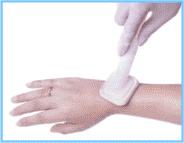
This is where CHG applicators play an important role.
A well-designed applicator helps healthcare professionals apply antiseptic consistently, reduce variation during preparation, and support standardized infection prevention workflows.
The applicator is not simply a container for antiseptic—it is a tool designed around real clinical needs.
From Clinical Needs to Product Design: HCY CHG Applicators
As infection prevention standards continue to evolve, medical device manufacturers are paying increasing attention to how products support healthcare professionals in daily practice.
At HCY, CHG applicator development focuses on the practical requirements of modern clinical environments, including consistent solution delivery, sterile manufacturing, reliable packaging, and ease of use.
HCY provides sterile CHG applicators in multiple capacities, including:
26 mL
30 mL
35 mL
40 mL
These options allow healthcare providers and OEM partners to select suitable configurations for different procedure requirements.
By combining medical device manufacturing experience with an understanding of clinical workflows, HCY aims to support safer and more standardized skin antisepsis practices worldwide.
Small Steps, Greater Patient Safety
The fight against surgical site infections is not based on one single technology.
It depends on many carefully controlled steps—from hand hygiene and sterile technique to effective skin preparation.
Behind every CHG applicator is a larger goal: helping healthcare professionals perform consistent infection prevention practices that protect patients before, during, and after procedures.
In modern healthcare, the smallest details often create the biggest impact.
We value your privacy We use cookies to enhance your browsing experience, serve personalized ads or content, and analyze our traffic. By clicking "Accept All", you consent to our use of cookies. Our Privacy Policy
 A professional supplier of swabs



-300x300.jpg "If You Time-Traveled to Ancient Times, How Many Lives Could You Save With One Box of CHG Applicators?")