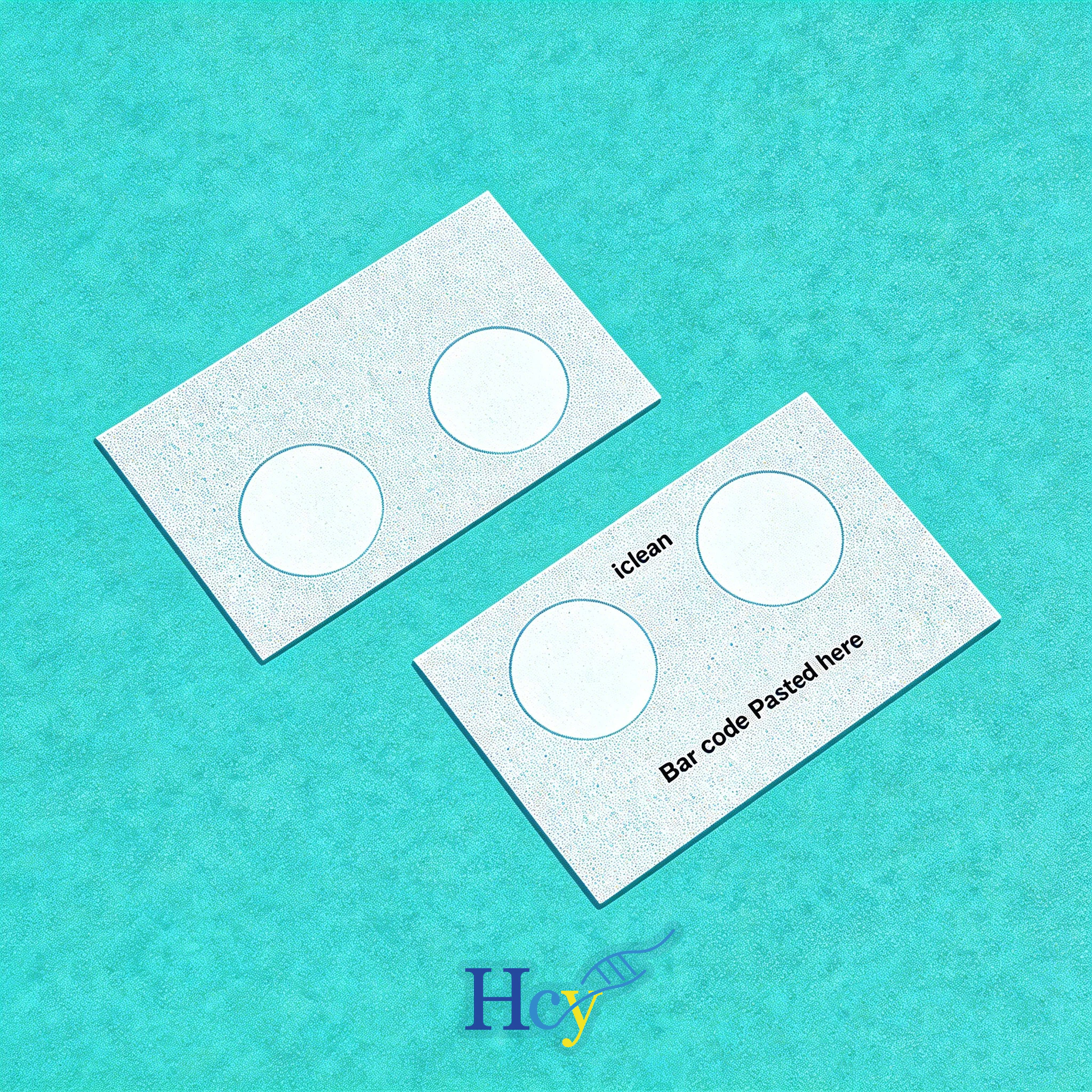
Ask ten different lab managers what makes a good DBS card, and you might get ten different answers. Some swear by the brand they inherited. Others stick with whatever their automation vendor recommends. And a surprising number simply say: “It’s just filter paper, right?”
Wrong.
In fact, the differences between DBS cards can be as dramatic as the difference between a supermarket plastic pipette and a calibrated laboratory micropipette. Both transfer liquid — but only one gives you confidence in the result. This article strips away the marketing noise and walks you through eight verifiable technical parameters that separate truly high‑quality DBS cards from the rest. And by the end, you’ll know exactly how to evaluate any supplier’s offering — including why one ISO 13485‑certified manufacturer quietly exceeds industry norms on nearly every metric.
Why “High Quality” in DBS Cards Is Not Just Marketing
It’s tempting to treat DBS cards as commodities. After all, they look similar: a piece of paper, some printed circles, maybe a desiccant packet. But peer‑reviewed literature tells a different story. Studies on immunosuppressive drugs (like tacrolimus and everolimus) have shown that different DBS cards produce significantly different recovery rates, hematocrit effects, and long‑term stability profiles. One card might over‑estimate drug concentration by 15% simply because of its paper matrix and coating.
That’s not a minor error — that’s a potential change in patient dosing.
The same principle applies to molecular diagnostics. A poorly manufactured DBS card can introduce PCR inhibitors, cause uneven blood spreading, or fail to protect RNA from degradation during ambient shipping. Quality isn’t a feel‑good label. It’s the difference between a reportable result and a wasted patient sample.
So let’s stop guessing. Here are the eight parameters that actually define DBS card quality — each one measurable, each one verifiable, and each one a potential hidden weakness in cheaper alternatives.
8 Technical Parameters That Define DBS Card Quality
1. Paper Matrix Purity and Consistency
The paper is not just a passive sponge. It is the primary interface between the blood sample and every downstream assay. High‑quality DBS cards use medical‑grade, low‑ash filter paper with highly uniform fiber distribution.
What can go wrong: Inconsistent fiber density leads to uneven blood wicking — some spots look darker, some lighter. Impurities (like metal ions or residual chemicals) can inhibit PCR reactions or cause non‑specific binding in immunoassays.
What to look for: A supplier that can provide certificate of analysis for paper lot numbers, including purity and uniformity metrics.
2. Spot Aperture Precision
This is one of the most overlooked but mechanically critical parameters. The printed circles on a DBS card need to be exactly where they are supposed to be — not 0.3 mm to the left, not 0.4 mm too small.
Industry typical tolerance: ±0.2 to 0.3 mm
Why it matters: Automated DBS punchers (e.g., from PerkinElmer, Camag, or others) align their punch heads to the printed spot. If the aperture position varies by more than ±0.2 mm, the punch may miss the center, cut the edge of the spot, or — worst case — miss the blood entirely. That means instrument downtime, reruns, and frustrated lab staff.
Leading indicator: A high‑precision 2‑spot DBS card can achieve ±0.1 mm aperture consistency. For example, Huayangyang’s 2‑spot cards are manufactured to this tighter tolerance, ensuring reliable feeding into mainstream automated punchers without alignment headaches.
3. Chemical Coating Uniformity
Most modern DBS cards are not plain paper. They are impregnated with chemical coatings that serve specific functions: lysing cells, denaturing proteins, stabilizing nucleic acids, or preventing bacterial growth.
What uniformity means: The coating must be applied evenly across the entire card and within each spot. Uneven coating leads to differential blood spreading — some spots wick faster, some slower — and variable analyte extraction.
How to check: Ask for coating batch records or perform a simple water‑wicking test on sample cards. Even spreading across all spots is a good sign.
4. Drying Time Efficiency
Drying time directly impacts sample integrity and laboratory logistics. Faster drying reduces analyte degradation, minimizes the “coffee ring” effect (where blood components migrate to spot edges), and allows cards to be packed and shipped sooner.
Industry typical room‑temperature drying time: 3 to 4 hours
Why it matters: Slow drying increases the risk of hemolysis, bacterial growth, and analyte instability — especially for RNA or labile proteins.
Better performance: Some premium DBS cards achieve drying in approximately 2.5 hours under standard conditions. Huayangyang’s 2‑spot cards, for instance, consistently hit this 2.5‑hour target, which helps labs shorten their workflow turnaround and improves ambient shipping reliability.
5. Long‑Term Analyte Stability
A high‑quality DBS card should preserve target analytes for years — not weeks — at room temperature. This is particularly critical for biobanking, retrospective studies, and remote screening programs.
Gold standard: DNA stability ≥ 5 years at room temperature when stored with desiccant in a dark, dry environment.
What to ask: Request accelerated aging data or real‑time stability studies. Huayangyang’s FTA‑compatible 2‑spot cards have demonstrated room‑temperature DNA stability for up to 5 years, matching the performance of far more expensive branded cards.
6. Anti‑Contamination and Fluid Barrier Design
Quality goes beyond the paper itself. A well‑designed DBS card includes physical features that prevent sample mishandling.
Independent ID zones: Separate areas for patient information or barcode labels that do not touch blood spots.
Fluid barriers: Printed or embossed rings that keep blood within the designated spot area, preventing lateral flow between spots.
Why it matters: Cross‑spot contamination can ruin multiplex assays. And a missing or smudged patient ID turns a perfectly collected blood spot into a forensic mystery.
7. Automation Compatibility
If your lab uses automated punchers, elution systems, or liquid handlers, the DBS card’s physical format must match your equipment.
Key dimensions: Card width, height, thickness, and spot spacing.
Common issue: Some cards are slightly thicker or thinner than the standard 0.5–0.6 mm, causing paper jams or poor punch quality.
What to verify: Request a sample pack and run 50–100 cards through your automation line before committing to a large order. A compatible card should feed smoothly with no misfeeds or registration errors.
8. Regulatory Certification and Manufacturing Standards
This is the ultimate filter. A DBS card may look perfect on paper, but without the right certifications, you are flying blind.
What to look for: ISO 13485 (medical device quality management), plus market‑specific registrations like NMPA (China), CE (Europe), TGA (Australia), MDEL (Canada), TFDA (Taiwan), and MHRA (UK).
Why it matters: ISO 13485 means the manufacturer follows documented design controls, risk management, and traceability. Non‑certified suppliers may change materials or processes without notice — introducing batch‑to‑batch variation that you will only discover after a failed validation.
Example: Huayangyang holds ISO 13485 certification along with NMPA, CE, TGA, MDEL, TFDA, and MHRA approvals. They also own over 82 medical device patents and comply with BSCI social compliance standards. That level of regulatory coverage is rare among DBS card manufacturers.
At a Glance: Industry Typical vs. High‑Quality Benchmark
The table below summarizes the eight parameters, comparing common industry baseline values against what a truly high‑quality DBS card — like Huayangyang’s 2‑spot design — delivers.
Parameter
Industry Typical
High‑Quality Benchmark (e.g., Huayangyang)
Paper matrix purity
Variable, often unspecified
Medical‑grade, low‑ash, batch‑controlled
Aperture precision
±0.2 – 0.3 mm
±0.1 mm
Chemical coating uniformity
Moderate
High, with consistent wettability
Drying time (room temp)
3 – 4 hours
~2.5 hours
Long‑term DNA stability
1 – 3 years
≥ 5 years at room temperature
Anti‑contamination design
Basic printed circles
Physical barriers + separated ID zone
Automation compatibility
General format
±0.1 mm precision, standard spacing
Regulatory certifications
ISO 9001 (sometimes)
ISO 13485 + NMPA, CE, TGA, MDEL, TFDA, MHRA
How to Use This Parameter List to Evaluate DBS Card Suppliers
Now that you have the eight parameters, here is a practical four‑step process to evaluate any DBS card supplier — whether you are considering a switch or validating a new vendor.
Step 1: Request a Full Specification Sheet
Do not accept “standard quality” as an answer. Ask for numeric tolerances on aperture precision, paper thickness, coating lot uniformity, and drying time data.
Step 2: Ask for Certificates
Specifically request the ISO 13485 certificate and any market‑specific registrations (CE, TGA, NMPA, etc.). If a supplier cannot produce them, that is a red flag.
Step 3: Run a Small Pilot
Order 100–200 cards. Test them on your actual automation line. Measure punch success rate, spot uniformity, and extraction efficiency compared to your current card.
Step 4: Check Long‑Term Stability Data
Request accelerated aging reports or real‑time stability studies for your analytes of interest (DNA, RNA, proteins, drugs). A quality supplier will have this data.
Conclusion: Quality Is Measurable, Not Just Claimed
DBS cards are deceptively simple. But behind that simple piece of paper lies a set of technical parameters that determine whether your assays succeed or fail, whether your biobank samples remain viable for years, and whether your automated line runs smoothly or stops every hundred cards.
The good news is that quality is not mysterious. You can measure aperture precision. You can time drying. You can verify certifications. And when you do, one pattern emerges: the manufacturers who consistently exceed industry norms are those with ISO 13485, tight process controls, and a willingness to share their data.
One such manufacturer is Huayangyang Technology. Their 2‑spot DBS cards deliver ±0.1 mm aperture precision, ~2.5‑hour drying, 5‑year room‑temperature DNA stability, and a regulatory footprint that spans five continents. But you don’t have to take that as a claim. Request a sample. Run your own tests. Check the eight parameters yourself.
Because in the end, the best DBS card is not the one with the loudest marketing — it’s the one that passes every parameter on your checklist. Quietly. Consistently. Verifiably.
Huayangyang Technology Co., Ltd. – ISO 13485 certified DBS card manufacturer with NMPA, CE, TGA, MDEL, TFDA, MHRA approvals. Over 82 medical device patents. Contact for OEM and technical data sheets.
We value your privacy We use cookies to enhance your browsing experience, serve personalized ads or content, and analyze our traffic. By clicking "Accept All", you consent to our use of cookies. Our Privacy Policy
 A professional supplier of swabs