 A professional supplier of swabs
Why Saliva Collection Cards Are Changing the Way DNA Samples Are Collected
294Discover how Saliva Collection Cards simplify DNA sample collection with easier handling, compact storage, and streamlined logistics for large-scal...
View detailsSearch the whole station Lab Supply
Imagine trying to solve a 50-year-old cold case with nothing but a dried spot of blood on a piece of paper. Sounds like science fiction? It’s actually science fact—and it’s all thanks to the remarkable evolution of DNA preservation technology. What began as simple filter paper for newborn screening has transformed into sophisticated chemical matrices that can preserve our genetic blueprint for decades at room temperature. Let’s take a journey through this fascinating technological evolution.
Our story begins in the early 1960s, when Dr. Robert Guthrie developed a simple method to screen newborns for metabolic disorders. He collected tiny blood drops on filter paper—what we now call Dried Blood Spot (DBS) cards . This was revolutionary for its time: no refrigeration needed, easy transport, and simple storage.
But here’s the catch—these early cards were just paper. They had no special chemical treatment. DNA on these cards would slowly degrade over time, broken down by enzymes, UV light, and oxidation. They were great for short-term storage, but ask them to preserve DNA for years? That was asking too much.
The 1990s brought a breakthrough that would change everything. Scientists at Flinders Technology Associates (hence “FTA”) developed something remarkable: paper impregnated with proprietary chemicals that could do what plain paper never could.
Here’s the magic of FTA technology:
Free radical scavenging: The cards contain compounds that neutralize the oxidative damage that fragments DNA over time
Cell lysis on contact: When a biological sample hits the card, the chemicals immediately burst cells open, releasing DNA
Protein denaturation: Enzymes that would normally chew up DNA are instantly deactivated
Nuclease protection: The chemistry creates an environment where DNA-degrading enzymes can’t function
Microbial growth prevention: Bacteria and fungi that could destroy samples simply can’t grow
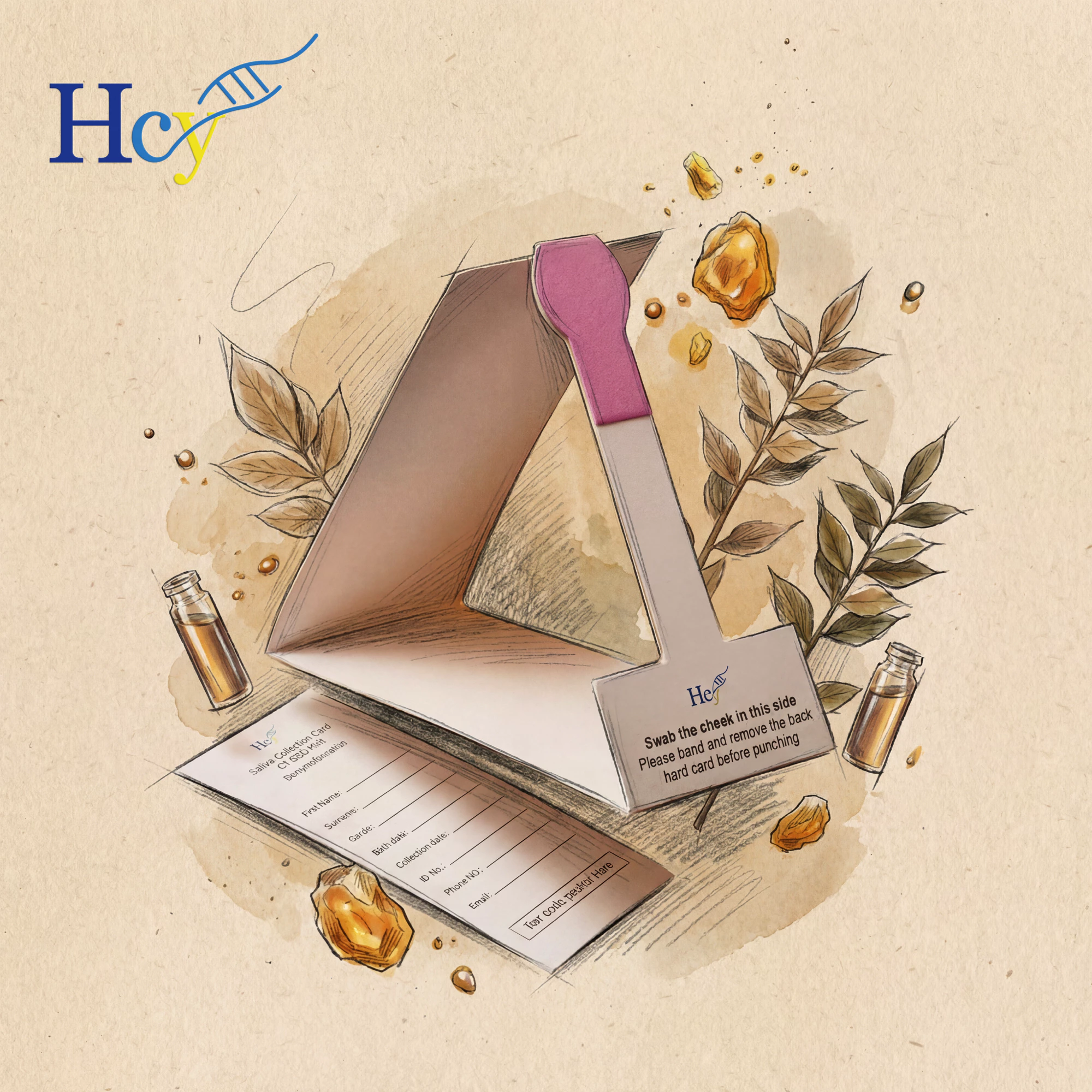
The result? DNA that stays stable for years at room temperature. A 2025 study demonstrated that nucleic acids stored on FTA cards remained stable for at least two months under temperatures ranging from -20°C to 37°C—with no statistically significant difference in preservation quality . That means you could mail a card across the equator in summer, and your DNA sample would arrive perfectly intact.
If FTA cards were revolutionary, today’s next-generation cards are nothing short of miraculous. Companies like Ahlstrom have pushed the boundaries with proprietary formulations that achieve what early pioneers could only dream of.
Take Ahlstrom’s GenSaver™ 2.0 technology, for example . These cards are crafted from high-purity absorbent cellulose fibers, then impregnated with a proprietary chemical formulation specifically designed to prevent environmentally induced degradation . The results are stunning:
Let’s translate these technical advances into practical benefits:
Early DBS cards might give you a few nanograms of degraded DNA—if you were lucky. Modern cards, combined with optimized extraction protocols, can yield high molecular weight DNA (>10 kb) suitable for whole-genome sequencing . A 2025 study showed that a customized extraction protocol from FTA cards yielded 14-fold more DNA compared to standard methods .
The chemical treatments in modern cards don’t just preserve DNA—they actively purify it. Proteins, hemoglobin, and PCR inhibitors remain bound to the card matrix while clean DNA is released during extraction . This means your downstream results aren’t compromised by contaminants.
Here’s where the numbers get impressive. While early cards might preserve DNA for months, modern technology offers:
How does this actually work? Modern preservation cards use multiple mechanisms working in concert:
Think of it as putting your DNA into a chemical time capsule—one that sits on a shelf at room temperature, waiting patiently for scientists to unlock its secrets decades later.
This evolution hasn’t happened in a vacuum. These technologies enable:
What’s next? Researchers are already working on cards that preserve not just DNA, but also epigenetic marks like DNA methylation . A 2025 study demonstrated that methylation patterns could be reliably recovered from FTA cards after over a decade of storage—opening new possibilities for studying how environment shapes gene expression over time .
From simple filter paper to chemically sophisticated preservation platforms, the evolution of DNA collection cards represents one of the quiet revolutions in modern biology. What began as a tool to screen newborns now helps solve cold cases, track endangered species, and unlock the secrets of our genome. And it all starts with a tiny drop of blood, saliva, or tissue—preserved on a card that fits in your pocket, waiting patiently for the day its DNA tells its story.
Discover how Saliva Collection Cards simplify DNA sample collection with easier handling, compact storage, and streamlined logistics for large-scal...
View details
Before they vanish forever, we are racing to preserve the microbial heritage of humanity.
View details
Saliva Cards vs. Liquid Tubes: Which is right for your study? We compare costs, logistics, and DNA quality. Discover how Dried Saliva Spot (DSS) te...
View details
Saliva Collection Card history, from dried sample collection to modern DNA testing, and its role in convenient, non-invasive sample collection.
View detailsWe value your privacy We use cookies to enhance your browsing experience, serve personalized ads or content, and analyze our traffic. By clicking "Accept All", you consent to our use of cookies.
Our Privacy Policy